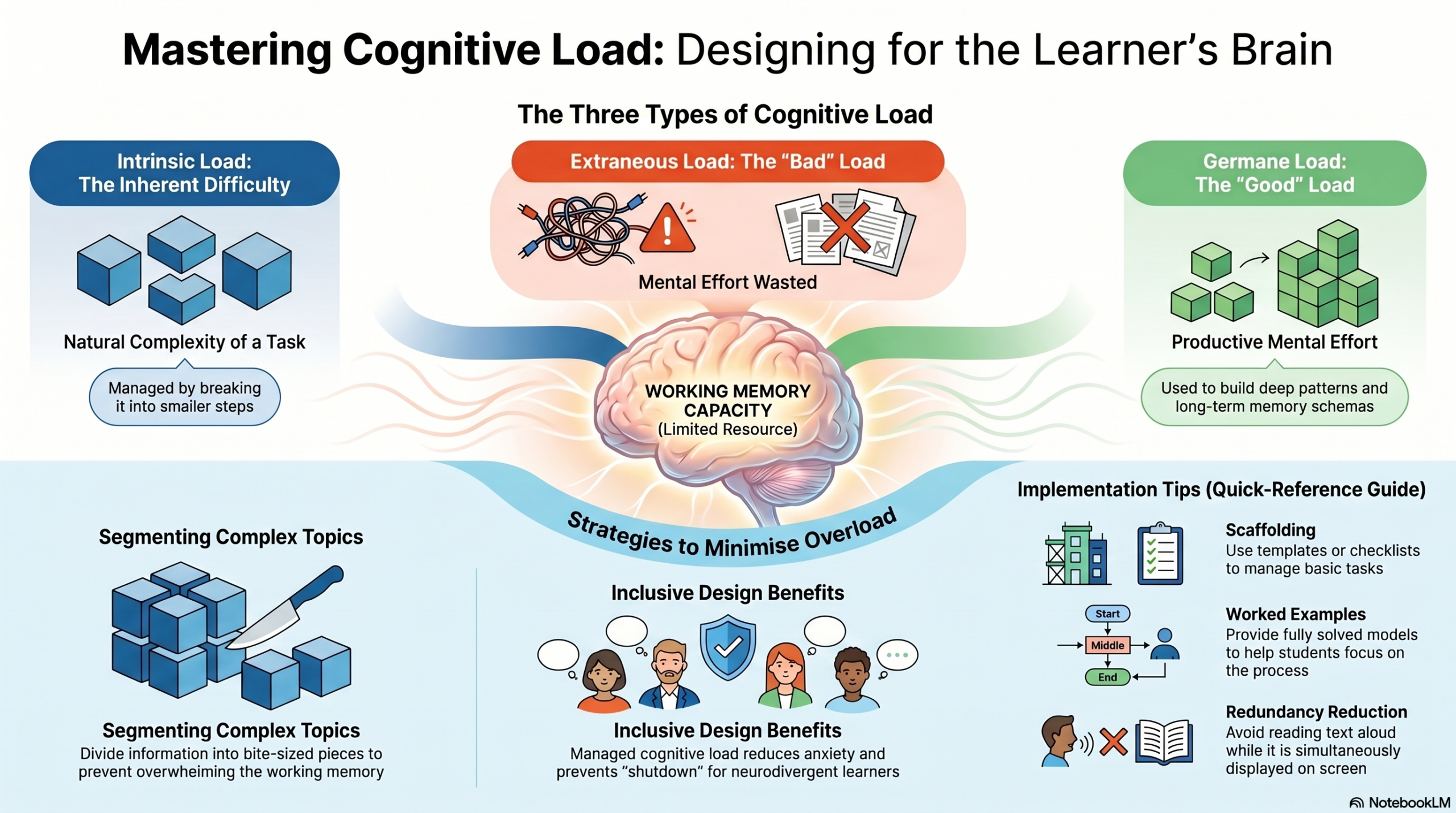
Cognitive Load Theory (CLT) posits that because our working memory has a limited capacity, instructional design must be carefully structured to avoid overwhelming the learner’s brain. When the cognitive load—the amount of mental effort being used—exceeds the capacity of the working memory, learning is inhibited.
1. The Three Types of Cognitive Load
To design effective instruction, educators must understand the three components that make up the total load on a student’s brain:
- Intrinsic Load: This is the inherent difficulty of the material itself, which cannot be changed but can be managed by breaking complex tasks into smaller, simpler steps.
- Extraneous Load: This is “bad” load generated by poor instructional design, such as distracting visuals, confusing instructions, or irrelevant information that interferes with learning.
- Germane Load: This is the “good” load devoted to deep processing—creating patterns, storing knowledge, and building schemas in long-term memory.
2. Strategies to Minimize Overload
| Strategy | Implementation Tip |
| Segmenting | Break complex topics into smaller, bite-sized pieces to prevent the working memory from being overwhelmed. |
| Redundancy Reduction | Avoid presenting the same information in multiple formats simultaneously—such as reading text aloud while it is also displayed on the screen—as this can distract the brain. |
| Scaffolding | Provide support structures, like templates or checklists, to reduce the extraneous mental effort needed to manage basic tasks. |
| Worked Examples | Provide fully solved problems or completed models so students can focus on understanding the underlying process rather than struggling to manage all steps at once. |
3. Supporting Diverse Learners
Managing cognitive load is particularly vital for inclusive settings, as it directly supports neurodivergent students who may have more restricted working memory capacity.
- Predictability: Reducing extraneous distractions helps students with ADHD or Autism maintain focus on the core learning objective.
- Reduced Anxiety: When a task is designed to be manageable, students are less likely to experience the “shutdown” or anxiety that often occurs when they feel overwhelmed by information.
- Building Schemas: By intentionally managing the load, teachers help students build stronger, more organized knowledge structures (schemas), which makes future learning more efficient.
4. Designing for “Germane” Focus
The ultimate goal is to remove all unnecessary “extraneous” load so that the student’s entire mental capacity can be directed toward “germane” learning.
- Clarity in Presentation: Ensure that all learning materials are clean, organized, and focused only on what is essential for the learning target.
- Monitor Engagement: Use formative feedback to check if students are “swamped.” If students are struggling with the basic steps, simplify the design or provide more scaffolding.
- Create Mental Habits: Teach students to break their own work into smaller chunks, helping them internalize the process of managing their own cognitive load.
Reflection
Cognitive Load Theory is a reminder that in teaching, “less is often more” when it comes to presenting new information. In your courses for kids, what is one “distractor”—such as a complex piece of jargon or an unnecessary feature—that you could remove to help your students focus more clearly on the core task?